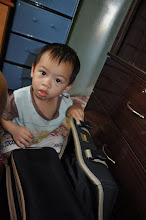
Secara ringkasnya saya boleh katakan tentang portraiture ialah: 1. Ia sesuatu yang subjektif. Seorang jurugambar perlu menilai fotograf yang diambil oleh expert atau portrait yang menjadi legend. Sering bertanyakan pada diri sendiri dan jika anda mentor, berbincang tentang sesebuah fotograf itu. Apa yang dinilai pada sebuah fotograf. 2. Terdapat pelbagai jenis portrait. Portrait bayi, kids, remaja, orang sedang bekerja, photojournalism portrait, CEO portrait, fashion/commercial, portrait, konvokesyen, wedding, senior dan sebagainya. Walau apa jenis portrait.. jurugambar perlu capture spirit subject tersebut. Mood, emotion, trauma etc.. feel subject itu. 3. Boleh dikatakan jika disebut portrait, kita sering bayangkan shot dari pinggang/dada ke atas. Oleh yang demikian, lensa 50mm adalah penting. Disamping bokeh yang cantik, 50mm memberi special feel. Selain dari itu, lensa 85mm dan 70-200mm memberikan impact tersendiri. Seorang jurugambar harus tahu membeza kesan yang diberikan oleh focal lenght terhadat kawalan perpektif dan tahu yang mana satu untuk digunakan untuk head shot dsbnya. 4. Praktikkan elemen composition dalam portraiture anda. 5. Dapatkan viewpoint yang lain(high angle & low angle), avoid distraction, isolate the image untuk mendapat portrait yang clean. 6. Mahirkan aspect lighting. Belajar memanipulasikan natural light dahulu. Then, jika ada kesempatan, belajar tentang studio light dan peralatan lighting yang lain. Lighting creates mood dan yang membezakan (selalunya) pro dan tak pro ialah kemahiran tentang lighting.. hehe.. Banyak otai buat kelas lighting.. sila belajar mereka. 7. Secara amnya, seorang portrait fotographer perlu pada berkomunikasi yang baik atau pandai bawa diri. Walaupun anda mungkin tak pandai bercakai dengan subject/model, tetapi pembawakan diri anda disenangi dan subject tidak menghiraukan kehadiran anda. Atau menganggap anda sebahagian dari pada mereka. Jika anda mengikut pro, cara bawa diri ini 'masuk' ke dalam diri anda secara tak lansung. Cara bercakap, penampilan diri etc. CUBA2 LA |
Wednesday, February 10, 2010
Portrait

Thursday, January 28, 2010
10 cara menangkap gambar berkualiti
- Gambar Dari Atas (Bermain dengan Perspektif)
- Posisi Objek Tidak Semestinya Di Tengah
- Latar Belakang Kosong Menonjolkan Objek (Bermain dengan Latar Belakang)
- Hijau Itu Indah – Taman lagi cantik
- 1, 2 Shoot. Jangan Kira! – candid mode
- Gambar Melalui ‘Sesuatu’ – reflection
- Gambar secara Simmetri
- Gambar Orang Yang Tengah Bergambar (Bermain dengan Objek/Fokus)
- Gambar Melalui Matahari (Bermain dengan Lens Flare)
- Kenali setting Kamera Anda (Bermain dengan Setting)
Jangan malu2 mau ambil gambar... tapi kalau pakai kamera HP tingu2 urang belakang juga la,..... ha ha ha
Friday, January 8, 2010
Nikon D90 part 2
The D90 works perfectly with all traditional AF, AF-I, AF-D and AF-S lenses.
No metering or EXIF data with manual focus lenses, you need at least a D300 to use these well. Then again, you always can guess exposure and correct based on looking at the LCD on playback, or play with it even faster in Live View, or you can buy a small light meter which will slip into the hot shoe.
The D90 has the same lens compatibility as the D80, D70, D100 and D50, which is better than the D40/D60, but worse than the D300.
The D90 provides automatic correction of lateral chromatic color fringes.
Details at Nikon Lens Compatibility.
read more
www.kenrockwell.com
No metering or EXIF data with manual focus lenses, you need at least a D300 to use these well. Then again, you always can guess exposure and correct based on looking at the LCD on playback, or play with it even faster in Live View, or you can buy a small light meter which will slip into the hot shoe.
The D90 has the same lens compatibility as the D80, D70, D100 and D50, which is better than the D40/D60, but worse than the D300.
The D90 provides automatic correction of lateral chromatic color fringes.
Details at Nikon Lens Compatibility.
read more
www.kenrockwell.com
Tuesday, November 17, 2009
DSLR Basic for beginner (Nikon-D90) part 1
Introduction
This will make you to an expert on using the Nikon D90, but this alone won't get great pictures.
To get great photos you still need to get yourself to the right place and point the camera in the right direction at the right time, which is a lot harder than mastering the D90. Technically, lighting and the use or disuse of flash is far more important to artistic synthesis than your choice of camera.
Right out of the box at default settings the D90 does a great job, but you need an eye to "see" the photos before you take them. The D90 is easy to master, but knowing how to make a great picture can take a lifetime. See all the previous links and How to Create a Masterpiece for more.
Once you get the right photo framed in your finder, there are two absolutely critical basic settings, which if set correctly, will give you extraordinary photos. Most people skip this, and are forever cursed with the same results regardless of how much they spend on new cameras.
Getting great photos out of the D90, or any other camera, really only takes these settings and a good eye:
1.) Take a picture. Look at the rear LCD. OK? You're done! If not:
2.) Too light or dark? Change the Exposure Compensation and shoot again. OK? You're done! If not:
3.) Colors not right? Adjust White Balance and try again. OK? You're done! If not:
4.) Contrast, saturation or other fine points not right? Adjust the Picture Controls. OK? GREAT! If not, you're either not at the right place, not at the right time, or looking in the wrong direction. It's never your camera's fault, but only human to blame it.
For more examples of why you'd want to change what settings and why, see my the "teaching" galleries on my Gallery page.
Making a great photo involves knowing what makes a great photo, knowing how to get great exposure, knowing when to use the D90's adjustments, knowing how to get great color, locations, timing, patience and a whole lot more. I cover general photography issues here.
Looking for a specific control? Use my Search page. Be sure to mention the D90 in your search.
Want free live phone support? In the USA, call (800) NIKON-UX, 24 hours a day, 365 days a year.
Below are the basics. Explicit details follow in later pages linked at the bottom.
Most of the settings I'll discuss are locked out in the green AUTO position on the top left mode knob. I don't use this position.
http://www.kenrockwell.com
Nikon D90

|
- Newly designed Nikon DX-format CMOS image sensor with wide ISO sensitivity range with low noise
- EXPEED for smooth tones, rich colors and fine details
- Innovative D-SLR movie function: D-Movie
- Scene Recognition System integrated with Face Detection System
- Easy-to-use Live View mode
- Picture Control System: Customize the visual style of your images
- Active D-Lighting for smooth tone reproduction in high-contrast lighting
- Versatile practical 11-point AF system
- Bright pentaprism viewfinder featuring frame coverage of approx. 96%
- Advanced Scene Modes for superior image quality
- Extensive palette of in-camera Retouch Menus
- Engineered for precision and durability
|
| Type of Camera | Single-lens reflex digital camera |
| Effective Pixels | 12.3 million |
| Image Sensor | Nikon DX format (23.6 x 15.8 mm) CMOS sensor |
| Image Size (Pixels) | 4,288 x 2,848 [L], 3,216 x 2,136 [M], 2,144 x 1,424 [S]; D-movie: 1280 x 720 / 24fps, 640 x 424 / 24fps, 320 x 216 / 24fps |
| Sensitivity | ISO 200 to 3,200 in steps of 1/3 EV, plus HI-0.3, HI-0.5, HI-0.7, HI-1 (ISO 6400); sensitivity decreases approx. LO-0.3, LO-0.5, LO-0.7 and LO-1 (ISO 100) |
| File Format | NEF (12 bit compressed RAW); JPEG (Baseline-compliant); AVI (Motion JPEG compression format with monaural sound) |
| Storage Media | SD memory card (SDHC compliant) |
| Shooting Modes | 1) Single frame shooting mode, 2) Continous low shooting mode: 1-4fps, 3) Continous high shooting mode: 4.5fps, 4) Self-timer mode, 5) Delay remote mode, 6) Quick-response remote mode 7) D-Movie |
| White Balance | Auto (TTL white-balance with 420-pixel RGB sensor), 12 manual modes with fine-tuning; color temperature setting; preset white balance; white balance bracketing |
| LCD Monitor | 3.0", 920,000-dot low-temperature polysilicon TFT LCD, allows up to 170-degree wide viewing angle |
| Playback Function | 1) Full frame, 2) Thumbnail (4, 9, 72 and calendar), 3) Magnifying playback, 4) movie playback, 5) Pictmotion, 6) Slide show, 7) Histogram indication, 8) Highlights point display, 8) Auto image rotation, 9) Image comment |
| Delete Function | 1) Card format, 2) All frames delete, 3) Selected frames delete |
| Interface | USB 2.0 (High-speed), GP-1 (GPS Unit) |
| Picture Angle (in 35mm [135] format equivalent) | Approx. 1.5x lens focal length |
| Viewfinder | Fixed eye-level pentaprism; built-in diopter adjustment (-2 to +1 m-1) |
| Focusing Screen | Type B BriteView Clear Matte Mark II screen |
| Viewfinder Frame Coverage/Magnification (with 50mm lens at infinity; -1.0 m-1) | Approx. 96%/ Approx. 0.94x |
| Autofocus | TTL phase detection by Nikon Multi-CAM 1000 autofocus module with AF-assist (range approx. 0.5-3m/1ft 8 in. - 9ft 10 in.); Detection range: -1 to +19 EV (ISO 100 at (ISO 100 at 20°C/68°F) |
| Focus Modes | 1) Autofocus (AF): Single-servo AF (AF-S); Continous-servo AF (AF-C); Auto AF-S/AF-C selection (AF-A), 2) Manual focus (M) can be selected from 11 focus area |
| Exposure Metering System | 1) 3D-Color Matrix Metering II (type G and D lenses); Color Matrix Metering II (other CPU lenses) performed by 420-segment RGB sensor, 2) Center-weighted: Weight of 75% given to 6, 8 or 10mm circle in center of frame, 3) Spot: Meters 3.5-mm circle (about 2.5% of frame) centered on active focus area |
| Exposure Metering Range (at normal temperature [68°F/20°C], ISO 100 equivalent, f/1.4 lens) | 1) 0 to 20 EV (3D-Color Matrix or Center-weighted metering), 2) 2 to 20 EV (Spot metering) |
| Exposure Control | 1) Digital Vari-Program (Auto, Auto [Flash Off], Portrait, Landscape, Sports, Close Up, Night Portrait), 2) Programmed Auto [P], 3) Shutter-Priority Auto [S], 4) Aperture Priority Auto [A], 5) Manual [M] |
| Auto Exposure Bracketing | 2 to 3 exposures in increments of 1/3, 1/2, 2/3, 1 or 2 steps to (+-) 1.0 EV |
| Maximum Shutter | 1/4000 |
| Minimum Shutter | 30 |
| Shutter | Electronically controlled vertical-travel focal plane shutter, 30 to 1/4000sec in steps of 1/3 EV plus bulb |
| Sync Contact | X-contact only; flash synchronization at up to 1/200 sec |
| Flash Control | 1)TTL flash control with 420-pixel RGB sensor; i-TTL balanced fill-flash and standard i-TTL fill flash available with SB-900, 800, 600 or 400, 2) Auto aperture available with SB-900, 800 and CPU lens 3) Non-TTL auto available with SB-900, 800, 28, 27 or 22s 4) Range-priority manual available with SB-900, 800. |
| Flash Sync Modes | 1) Auto, 2) Fill-in flash, 3) Red-eye reduction, 4) Red-eye reduction with Slow sync, 5) Slow sync, 6) Rear-curtain sync, 7) Off |
| Self-Timer | Electronically controlled timer with duration of 2, 5, 10 or 20 s. |
| Depth of Field Preview Button | Yes |
| Remote Control | Via Wireless Remote Control ML-L3 (optional) |
| GPS | via GP-1 GPS Unit (optional) * This product shall not be exported without authorization from the appropriate governmental authorities. |
| Supported Languages | Total of 17 languages: Chinese (Simplified and Traditional), Danish, Dutch, English, Finnish, French, German, Italian, Japanese, Korean, Norwegian, Polish, Portuguese, Russian, Spanish, Swedish |
| Power Requirements | Rechargeable Li-ion Battery EN-EL3e, AC Adapter EH-5a (optional) |
| Battery Life (on a fully charged battery) | Approx 1,000 shots |
| Tripod Socket | 1/4 in. (ISO1222) |
| Dimensions | Approx. 132 x 103 x 77mm |
| Weight (without battery, memory card or body cap) | Approx. 620g |
| Supplied Accessories (may differ by country or area) | Rechargeable Li-ion Battery EN-EL3e, Quick Charger MH-18a, USB Cable UC-E4, Video Cable EG-D2, Camera Strap AN-DC1, Body Cap BF-1A, Accessory Shoe Cover BS-1, LCD Monitor Cover BM-10, Software Suite CD-ROM |
| Other Features | Retouch menu, Info Display on LCD monitor, Intergrated Dust Reductions System, Live view (with face-priority AF), D-Movie |
Price: RSP RM 4,688.00 (with AF-S DX Nikkor 18-105mm f/3.5-5.6G ED VR); RSP RM 3,688 (body only)
Subscribe to:
Posts (Atom)